

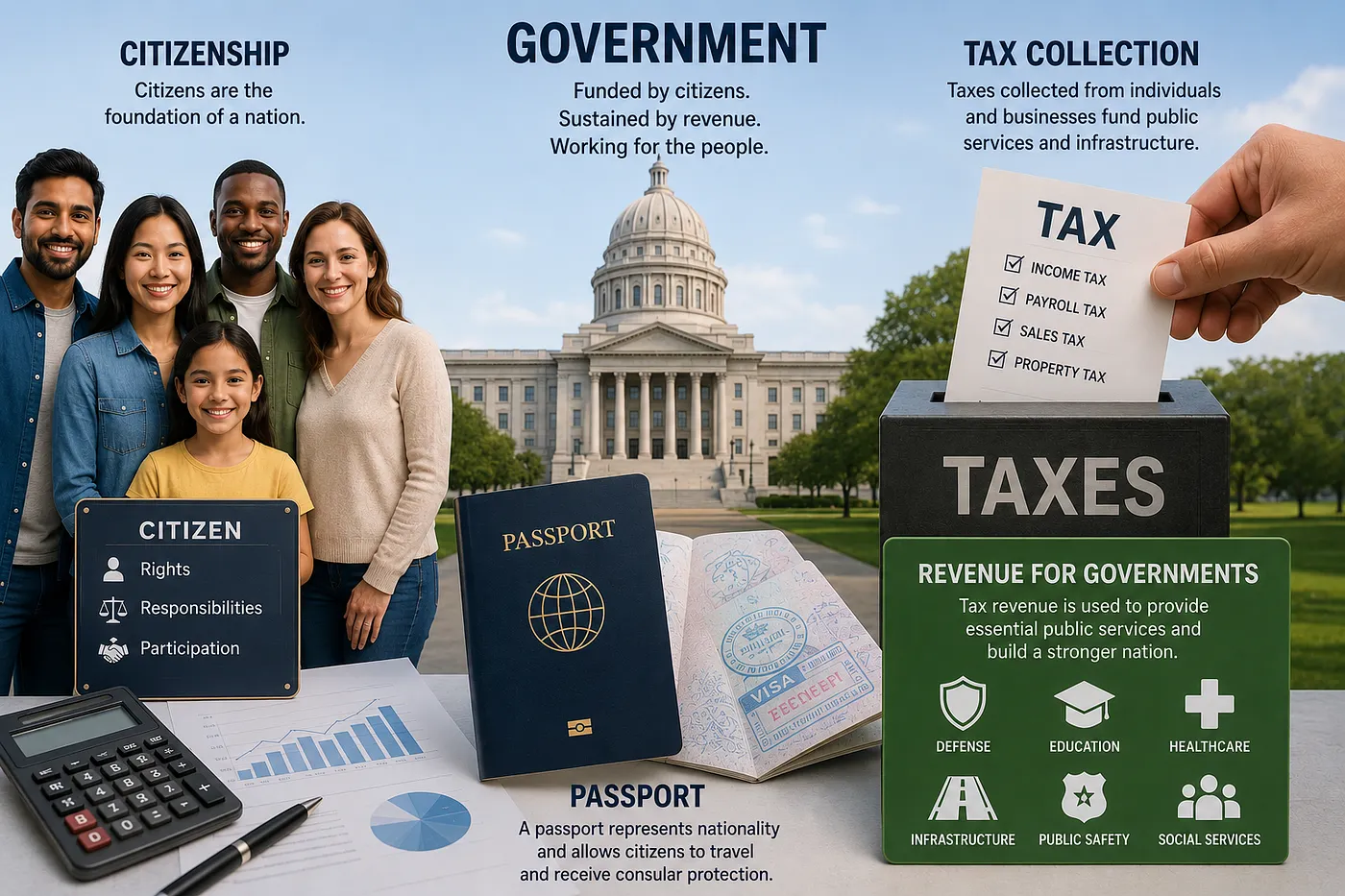
We are pleased to introduce our brand new model — Citizenship by Taxation (CBT) — a steady source of revenue for sovereign governments. Our CBT model is a superior model and successor to traditional Citizenship by Investment (CBI) programs.
For the first time in history, we introduce a Citizenship Tax (CT) a special citizenship tax that can be plugged into several investment structures.
History
Citizenship and taxation have had special connection since ancient times. The earliest known Tax originated around 3000 B.C. in Ancient Egypt, where the Pharaoh collected grains as tax from harvests. The Roman Empire, strategically used “citizenship” to turn foreign subjects into taxable citizens as a way to expand its empire, increasing tax collection.
I respectfully submit this proposal for your Government’s consideration.
The CBI Market
The global CBI industry, valued at around USD 50 billion annually, is at a critical inflection point. The April 2025 ruling of the Court of Justice of the European Union against Malta’s program — declaring that citizenship cannot be a “mere commercial transaction” — has destabilised the legal foundations of every CBI program with treaty obligations to the EU. Several jurisdictions (Cyprus, Malta, Bulgaria, Montenegro, Moldova) have already terminated their programs, and Caribbean states have faced visa-waiver pressure from the UK, US, and Canada.
Governments that built fiscal dependence on CBI revenue now urgently require a legally defensible alternative. CBT is precisely that alternative.
The CBT Concept
Under CBT, an applicant earns a discretionary naturalised citizenship by becoming a genuine, recurring taxpayer. The applicant enters a Tax Agreement with the State, paying a fixed Citizenship Tax (CT) over a defined period (typically 12 months to 5 years), establishing real fiscal residency before citizenship is granted.
The philosophical distinction from CBI is fundamental: CBT does not sell citizenship. It recognises taxpayers — the same basis upon which every natural-born citizen holds their civic status.
Revenue Potential for Your Governments
For a small-state implementation processing 1,000 applicants per year at a USD 10,000 monthly Citizenship Tax:
• Flat tax stream (90% of applicants): USD 108 million annually
• Real estate stream (5%): USD 10 million plus property tax, stamp duty, and capital gains
• Bond stream (5%): USD 10 million
• Family dependent fees: USD 15 million
• Agent licensing fees: USD 1 million
Total recurring annual State revenue: approximately USD 144 million per 1,000 applicants per year — recurring, not one-time.
Strategic Benefits
- Stable Recurring tax revenue rather than one-time windfalls — superior for long-term fiscal planning.
- Highly tunable model for revenues.
- Legally distinguishable from CBI under EU law, OECD tax standards, and FATF AML frameworks.
- Establishes a “genuine link” between citizen and State — addressing the central criticism of CBI.
- High standard vetting with 12-month rolling due diligence — far stronger than any current CBI vetting standard.
- Foreign Tax payers are given automatic tax residency and residence visa until citizenship is granted.
- All payments routed directly to the tax authority — eliminating the corruption risks associated with agent intermediation.
- Bond option can be used to reduce IMF debt or build natural-disaster reserves.
- Attracts foreign direct investment, skilled professionals, businesses, and real estate development.
Investment Structures
The Citizenship tax can be plugged into these investment structures which can create economic boom in the country.
- Flat Tax — A fixed tax levied monthly or quarterly or annual (starting $100,000 per year to $5 million) depends on the country requirement.
- Real Estate — Minimum real estate purchase (starting $200,000) and fixed percent of CT levied. In addition governments can receive all property taxes, capital gain tax from rental income.
- Business — Businesses creating jobs attracting skilled workers can sponsor citizenships based on their turnover. A fixed percent of citizenship tax levied.
- State securities — Sale of government issued bonds or securities starting $200,000. A percent of citizenship tax (eg. 10%) levied based on bond value. Securities are locked for 5 years and interest goes to tax authority or ministry of finance.
How it works?
The criteria and working of the CBT program can be tailored and customized to governments. Here is a base model
- Investor commits to tax payments
- Applies for Tax number from Tax office.
- Starts making investment and tax payments for minimum defined period.
- Undergoes Vetting and due diligence
- Assigned tax residency and residence visa to visit (upon passing checks)
- Makes personal visit for biometrics
- Completes Tax obligations with Tax office.
- Files for Naturalization.
- Establishes strong ties to the country.
- Ongoing monitoring of due diligence
Implementation
Our CBT model can be used at no cost for governments to implement. Zero upfront cost to your Government. Implementation involves:
• Codification of the Citizenship Tax within the Tax Code (to issue tax residency)
• Amendment of immigration and naturalisation law to recognise discretionary citizenship for tax payers
• Establishment of an independent oversight board with international representation
• Legalisation of dual citizenship (where not already in place)
• Integration with international law, FATF and OECD frameworks
Our firm offers full design, implementation, and consultation support, compensated solely as a percentage of revenues raised — meaning no fiscal risk to the State.
The White paper is available for free download